BJJ Terms for Beginners: A Plain-English Glossary
This guide explains common BJJ terms for beginners without assuming you already know the sport. You do not need to memorize every word before class. Learn the safety terms first, recognize the major positions, and let the rest become familiar through drilling.
Brazilian jiu-jitsu has vocabulary from grappling, wrestling, judo, and decades of gym culture. Coaches may use slightly different names for the same movement. When you are unsure, ask what the term means and follow the demonstration. A clear question is more useful than pretending you understood.
BJJ terms for beginners: the quick list
- Tap: The signal to stop a submission or any situation you do not want to continue.
- Drill: Practice a technique repeatedly with a cooperative partner.
- Roll: A live practice round where both people work to improve position or apply technique.
- Position: The relationship between the two people, such as guard, mount, or side control.
- Submission: A controlled technique intended to make a partner tap.
- Gi: The jacket, pants, and belt worn in gi jiu-jitsu.
- No-gi: Jiu-jitsu practiced in fitted athletic clothing without the gi.
Those seven definitions are enough to follow many first-day explanations. The rest of this jiu jitsu glossary gives you more context for what the coach and your partner may say.
What does tapping mean in BJJ?
Tapping means stop. You can tap your partner or the mat with your hand, tap with your foot when your hands are trapped, or say “tap” clearly. The other person should release immediately.
You do not need to wait until a technique hurts. Tap when you recognize that you are caught, feel unsafe, or simply want the action to stop. Tapping is a routine safety and learning skill, not a confession that you do not belong. Reset, ask a question if appropriate, and continue only when you are ready.
What does rolling mean in BJJ?
If you are asking what does rolling mean in BJJ, it is the common term for live practice. Unlike drilling, both partners are making decisions and offering resistance. A roll may begin from standing or from a specific ground position, depending on the coach's directions.
Rolling is not a real fight and should not be treated like one. The goal is to practice timing, control, escapes, and submissions with a partner who also needs to train tomorrow. At Great Lakes BJJ, live rounds are always optional. You can drill the lesson, observe, or sit out a round.
What are the main BJJ positions?
Guard is a family of positions where the person underneath uses their legs and body position to manage the person on top. Closed guard wraps both legs around the other person's waist. Open guard uses the feet, legs, grips, and distance without keeping the legs locked.
Half guard usually means the person underneath has trapped one of the top person's legs. There are many versions, but a beginner mainly needs to recognize that it is different from full guard and that both people have specific goals.
Side control is a top position across the other person's torso. The person on top works to control movement. The person underneath usually works to create space, protect their arms and neck, and recover guard or turn into a safer position.
Mount is a top position where one person is over the other person's torso with a knee on each side. Back control means controlling from behind, often with the legs positioned around the partner's hips. Both are strong controlling positions, but position alone does not end a round.
North-south is a top position where the two people face opposite directions. The name describes the orientation, not a separate rule set.
What do pass, sweep, escape, and reversal mean?
A guard pass moves the top person beyond the bottom person's legs into a controlling position such as side control. “Passing” usually refers to solving the guard rather than simply running around someone.
A sweep is a technique initiated from guard that puts the guard player on top and meets the rules or definition being used in that class. People sometimes use “sweep” casually for any bottom-to-top change, but coaches may distinguish it from a reversal, which changes the position from somewhere other than guard.
An escape moves you out of a disadvantageous position or submission threat. Beginners spend a great deal of useful time learning how to frame, make space, protect themselves, and return to a more workable position.
What are base, posture, frames, and pressure?
Base is your ability to stay balanced and difficult to tip over. Where you place your hands, knees, and feet affects your base. Posting a hand or foot can help prevent a sweep, but a coach should show you when and how to do it safely.
Posture is the organized position of your head, spine, hips, and limbs for the task. Good posture in closed guard looks different from posture during a takedown or guard pass.
A frame uses the structure of your arms or legs to create and maintain space. Framing is not the same as pushing with all your strength. Correct bone alignment can help you manage pressure with less effort.
Pressure means applying controlled body weight, connection, and direction to limit movement. Effective pressure is technical. It is not permission to ignore your partner's safety or a tap.
What are common submission terms?
A choke is a submission aimed at the neck. An armbar controls and extends the elbow. A kimura and Americana are bent-arm shoulder locks with different orientations. A triangle uses the legs in a configuration around the neck and an arm.
Knowing a name does not mean you should attempt the technique without instruction. Learn the control, finishing direction, and release expectations from a coach. Apply submissions gradually and give your partner time to tap.
What do takedown, breakfall, and technical stand-up mean?
A takedown brings the action from standing to the ground with control. A breakfall is a practiced way to distribute impact and protect yourself when falling. Do not invent your own fall based on a written definition. Learn it through coached practice.
A technical stand-up is a method of returning to your feet while protecting balance and managing distance. Details vary with context, but the term often appears in beginner and self-defense lessons.
What is the difference between gi and no-gi?
Gi jiu-jitsu uses the traditional uniform, and the fabric can be used for legal grips and techniques. No-gi jiu-jitsu uses fitted athletic clothing, and gripping focuses on the body rather than the uniform. Our gi vs no-gi guide compares the two formats in detail.
For a gi class at Great Lakes BJJ, bring your own clean gi. The gym does not have loaner gis. For no-gi, choose a fitted athletic shirt and grappling shorts or leggings without zippers, metal, or loose pockets.
Do beginners need to understand points and belts?
Not on the first day. Points are used in many competition rulesets to reward particular takedowns, sweeps, passes, and controlling positions. Rules can differ by organization, age, and event. Your coach will explain the scoring system when it matters.
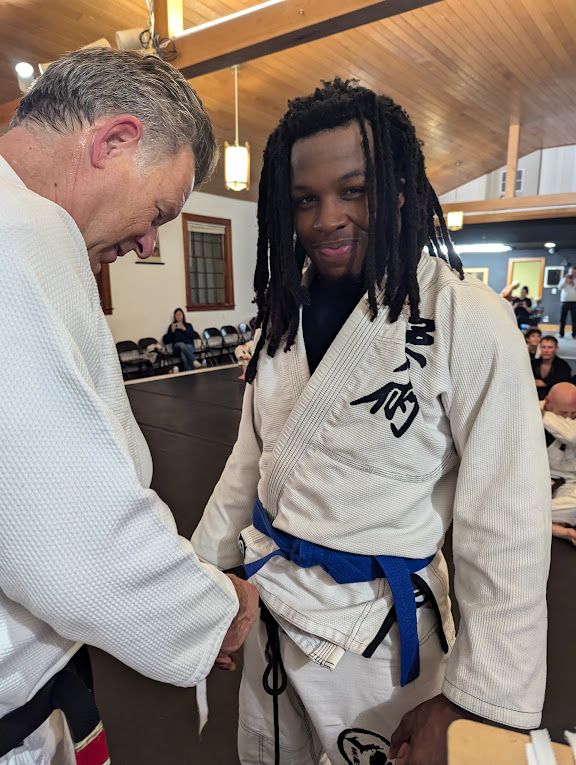
Adult BJJ belts commonly progress from white to blue, purple, brown, and black. Belt standards and timing depend on the academy and the student's demonstrated development. A beginner's immediate job is simpler: learn safe habits, understand the current lesson, and return consistently.
Using this glossary in your first Flint class
Read the first-class walkthrough, then use the current schedule to choose a visit. Great Lakes BJJ beginner-designated sessions sometimes run separately and sometimes within an all-levels class. They are group lessons, and you may work with people who have different experience levels.
The beginner jiu-jitsu page, adult training overview, and Flint jiu-jitsu guide explain the program and training environment. If your interest is practical safety, our article on BJJ and self-defense separates training benefits from unrealistic guarantees.
Eligible adult beginner programs include a 14-day trial. Request your first class, tell a coach you are new, and ask whenever a term is unclear. You are not expected to speak the language before you begin learning it.