Do You Need to Be in Shape to Start Jiu-Jitsu?
You've thought about training for months, maybe longer. And every time you get close to actually walking in, the same thought stops you: I should get in shape first. Drop some weight, get the cardio back, then start. You don't want to be the person gassing out in the corner while everyone watches.
Here's the honest answer, and it's the same one I give every adult who tells me this. No, you don't need to be in shape to start jiu-jitsu. Waiting until you're fit is backwards, and I'll explain exactly why.
You don't get in shape to start. You get in shape by training.
The logic feels responsible. Get the body ready, then ask it to do hard things. But it runs the process in the wrong order. Nobody gets in shape and then starts jiu-jitsu. They start jiu-jitsu, badly and out of breath, and the shape comes from the training itself. The people who wait until they're ready are usually still waiting a year later, because "in shape enough" is a finish line that keeps moving.
There's a second half to this that almost nobody realizes going in. The shape you build from grappling is its own kind, and nothing you did before fully prepares you for it. Running doesn't. Lifting doesn't. Cycling, swimming, none of it maps cleanly onto what happens when another person is actively trying to control your body and you're trying to stop them. It's a different engine. Even people who show up genuinely fit from another sport breathe hard their first few weeks. That's not a sign you're behind. That's the sport introducing itself.
What "out of shape" actually looks like on the mat
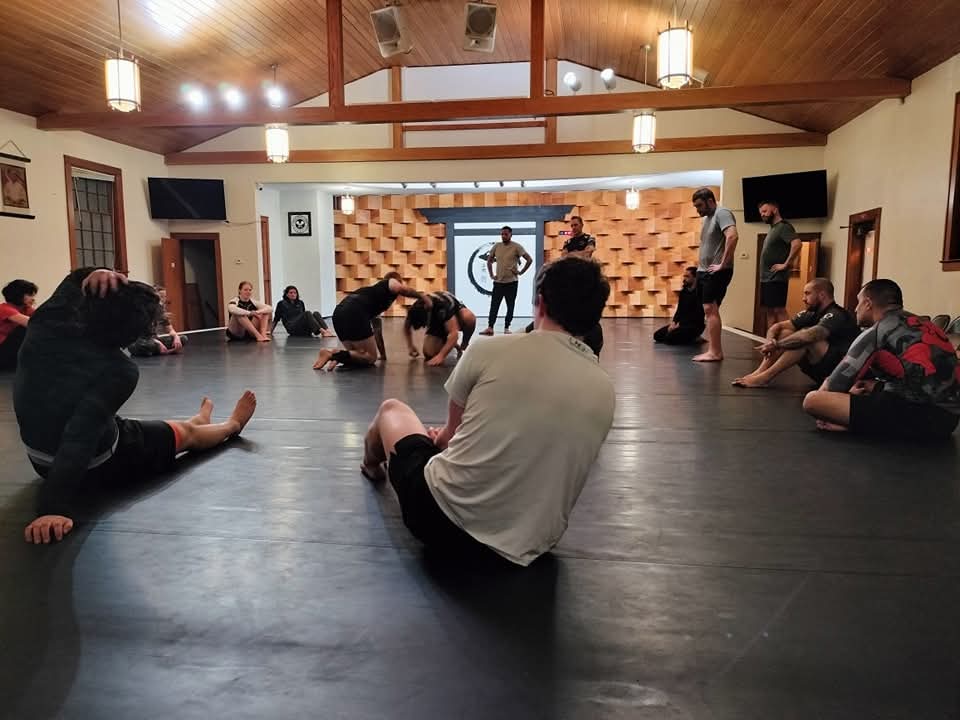
You're picturing yourself as the one person who can't hang. What actually happens is you breathe heavy, you take a break, and you get back in. That's it. Breathing hard is expected here. We don't penalize it and we don't make a thing of it. Knowing your limits and taking a break when you need one is encouraged, not frowned on. The room is full of adults who started soft and winded, because most adults start soft and winded.
The fear underneath the fitness worry is usually not really about fitness. It's about being embarrassed. About looking incompetent in front of a room. I get it, and I'll tell you the truth: on day one, everyone is bad at jiu-jitsu, and everyone in that room remembers being exactly as bad as you're about to be. The embarrassment you're bracing for mostly lives in your head on the drive over. It's gone by the second class.
Learn to breathe, learn to relax, then everything else
A lot of what feels like "I'm too out of shape for this" early on is actually a skill problem, not a fitness problem. New people gas out fast because they muscle everything. Every position becomes a max-effort struggle, so of course the tank empties in three minutes. As you learn to relax, to use leverage instead of panic, to breathe through a bad spot instead of holding your breath and thrashing, your cardio in the context of grappling improves dramatically, even before your general fitness changes much. The efficiency is the fitness. That comes with reps, not with treadmill time beforehand.
I say the cardio comes from training partly from experience. I spent years in combat sports where the whole thing came down to who broke first, and the lesson that kept repeating was that power and even raw conditioning run out. Skill, composure, and knowing how to manage your own gas tank are what actually carry you. That's true at the highest level and it's true on your first night. You don't need a bigger engine to start. You need to learn to drive the one you have.
The frustration is the first thing we coach
Here's the part I want you ready for, because it's more real than the cardio. In your first weeks you will get frustrated, and it won't be with your lungs. It'll be with the fact that your body can't yet do the thing you just watched someone show you. You'll drill a move, feel like you have it, and then completely fail to pull it off thirty seconds later. That gap between understanding something and being able to do it is the real first lesson of jiu-jitsu. It isn't a technique. It's learning to stay patient with yourself while your body slowly absorbs something hard.
When someone gets stuck on this, I point them back to elementary school. Think about how long it took to learn the letters of the alphabet. Then to string letters into words. Words into sentences, sentences into paragraphs, paragraphs into stories. At every level, just knowing the pieces wasn't enough. You had to understand what each one meant, and that took time and repetition. Jiu-jitsu is the same. Right now you're learning the alphabet. Fluency comes later. Once you see that you're not failing, you're just at the right step for where you are, the frustration lets go of you.
So what do you actually need to start?
Comfortable clothes you can move in, a water bottle, and a willingness to breathe hard and be a beginner for a little while. That's the entire list. Not a fitness base, not a weight-loss head start, not a month of cardio first. Our beginner classes are built for exactly this, for people walking in from a desk or a factory floor or a long stretch of no training at all. You can see all the adult options once you've got a feel for it, but the front door is the beginner class, and it's open to you at whatever shape you're in today.
The people who are glad they started never say they wish they'd waited until they were fitter. They say they wish they'd started sooner. There's a 14-day free trial for you, no contracts, nothing to cancel. Come breathe hard with the rest of us. If you've got a question first, message us and I'll give it to you straight.
See you on the mats,
Coach Adam